We were established as the most specialized mineral processing equipment company since 1985.

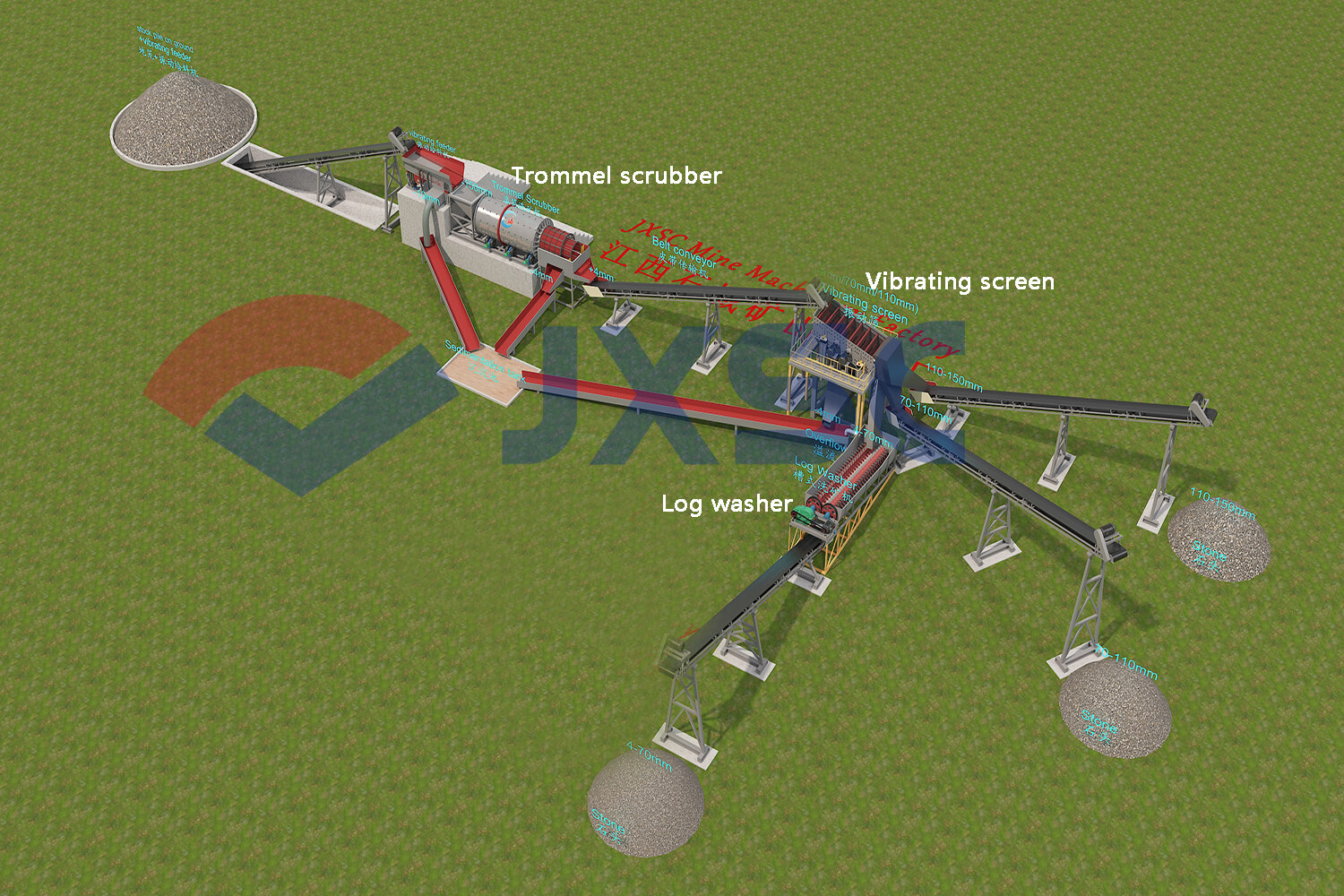
This case study is a 200 TPH magnesite washing process plant in Tanzania. Given that the ore surfaces are heavily coated with sticky clay and argillaceous impurities, the plant employs a core process consisting of multi-stage pre-screening, drum scrubbing, three-layer precision classification, and a secondary scrubbing stage. This configuration ensures the thorough removal of clay, mud, and other surface impurities, followed by precise size-based classification. This magnesite washing process solution ultimately produces three finished products: 4–50 mm (output 70–80 TPH), 50–100 mm, and 100–150 mm, which can meet the customer’s dual requirements for finished product particle size and cleanliness. The entire production line consists of only 7 sets of core equipment. The process is simple, with few points of failure and a closed water circulation system, which balances washing and screening effects, low operating costs, and environmental protection requirements.
Run-of-mine ore is discharged by dump trucks or excavators into a hopper equipped with a grizzly screen featuring 150 mm openings. Material larger than 150 mm is retained on the screen and stockpiled nearby, while material smaller than 150 mm passes through the screen into a vibrating feeder located below, thereby completing the initial separation of coarse and fine fractions.
The vibrating feeder is equipped with grizzly bars spaced 10 mm apart, which serve a pre-screening function. Material ranging from 10 to 150 mm is fed uniformly into the rotary ore washer for processing, while fine material smaller than 10 mm flows directly into a settling tank. This facilitates the recycling of process water, thereby achieving the dual objectives of water conservation and waste reduction.
The trommel scrubber has a high washing efficiency. Its screening section is equipped with two layers of polyurethane (PU) screens with apertures of 4 mm and 20 mm, respectively. The 20 mm screen protects the 4 mm fine screen and extends its service life. Through vigorous scrubbing, clay and argillaceous material on the ore surfaces are thoroughly removed. Material passing through the 4 mm screen is directed into the aforementioned settling tank, while the material retained on the screens (4–150 mm) is transported via a belt conveyor to a vibrating screen for the next stage of the process.
The vibrating screen is equipped with three layers of screens with apertures of 4 mm, 50 mm, and 100 mm, for further precise grading of materials. Material passing through the 4 mm and 50 mm screens (the 4–50 mm fraction) is directed into a spiral ore washer, while the intermediate fraction (50–100 mm) and the oversize fraction (100–150 mm) are transported via belt conveyors to their respective product stockpiles, allowing for the separate storage of different-sized finished products.
A log washer is used to perform a secondary wash on 4–50 mm material. This scrubbing stage further removes residual clay and impurities, significantly enhancing the cleanliness of the final product and ensuring it meets customer requirements for high-quality finished material.