We were established as the most specialized mineral processing equipment company since 1985.

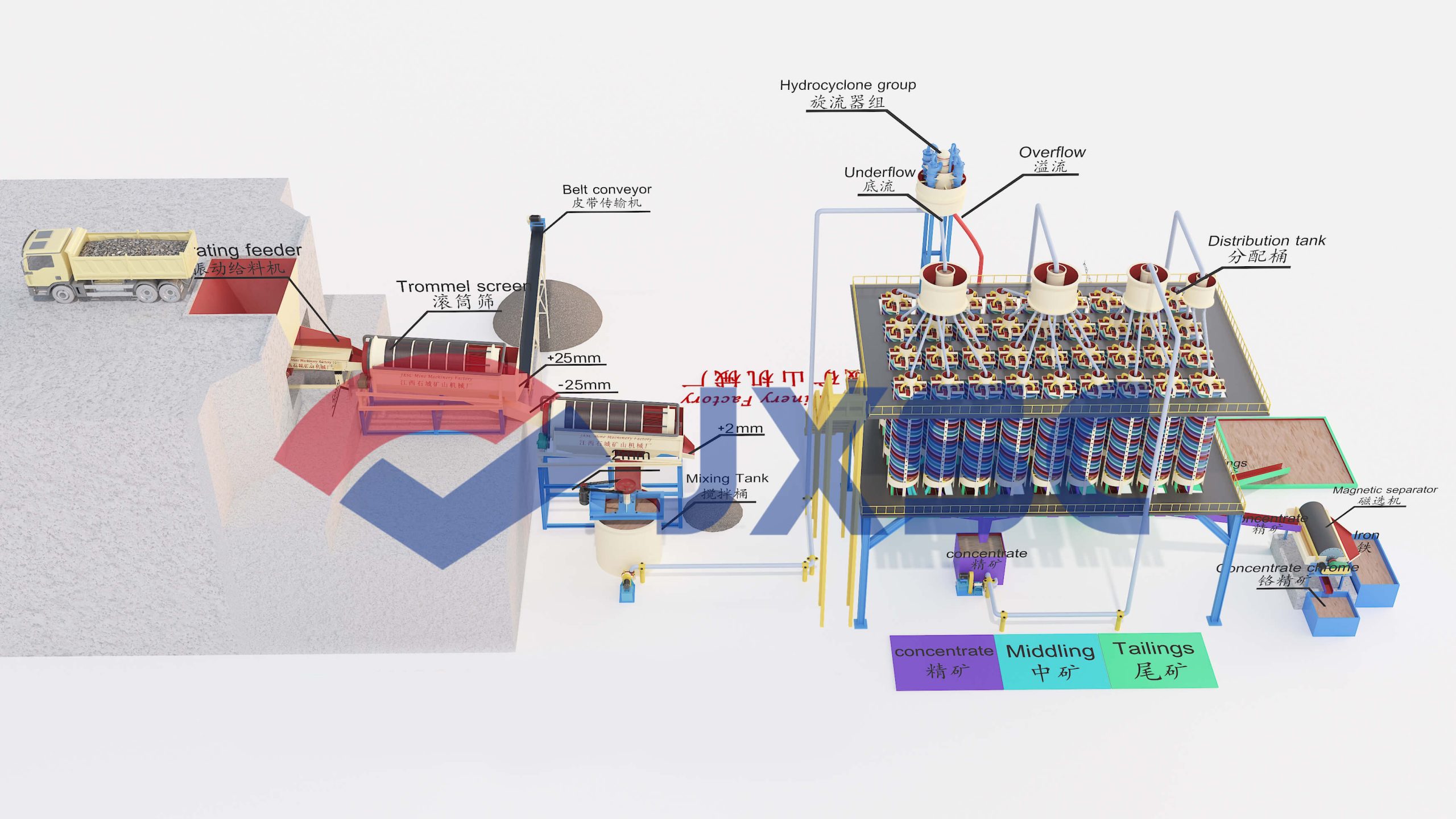
This is a complete 50TPH lateritic chrome ore beneficiation plant project. Characterized by high slime content and a large proportion of ultra-fine particles, this ore is a typical alluvial type that is difficult to process and has a relatively low chromium grade. JXSC tailored a combined process flow for the client, centered on “dual-stage screening and impurity removal, cyclone classification, multi-stage spiral chute gravity separation, and magnetic separation for purification.” Specifically, 36 sets of spiral chutes are arranged in a 12+12+8+4 gradient configuration for progressive enrichment, ensuring both high chromium recovery rates and superior concentrate grades. Magnetic separation is subsequently employed to further remove iron impurities, ensuring the chrome concentrate meets quality standards for sales or smelting and enhancing the product’s added value. This lateritic chrome ore beneficiation solution has significant advantages, such as a strong adaptability, high recovery rate, and low operating cost, which fully meet the needs of African customers.
50 TPH Lateritic Chrome Ore Beneficiation Plant
Run-of-mine (ROM) lateritic chrome ore is loaded into the feed hopper by a loader or dump truck. A vibrating feeder then conveys the ore evenly and steadily to the next stage, preventing sudden overloads that could damage or clog the screening equipment.
Large pieces of waste rock (+25mm) on the first stage trommel screen are directly discharged via belt conveyor and stored or backfilled as waste. The undersized material (-25 mm) proceeds to the second-stage rotary screen. Medium-sized waste rock (+2 mm) from the second-stage screen is discharged directly. Ultimately, only the -2 mm chrome-bearing slurry advances to the subsequent beneficiation stage.
The -2 mm slurry enters the mixing tank, where agitation keeps the solid particles uniformly suspended and prevents settling; it is then pressurized and transported by a slurry pump to a cyclone for hydraulic classification.
The hydrocyclone underflow consists of coarser particles enriched in chromium-bearing minerals and is fed directly to a bank of spiral chutes for gravity separation. The overflow, comprising fine slimes and ultrafine particles, is sent to a settling pond for natural sedimentation; the supernatant is recycled into the production process, while the settled sludge is discharged as tailings.
A four-stage gravity separation configuration is adopted for progressive enrichment: First stage (12 groups): The hydrocyclone underflow is coarsened to separate a large amount of tailings and coarse concentrate. Second stage (12 groups): The rough concentrate is further processed, and the tailings are further removed to improve the grade of the concentrate. Level 3 (8 Group): Fine refining operation to further enhance the enrichment ratio of chromium in the concentrate. Level 4 (4 Group): Final cleaning/scavenging, producing high-grade chromium concentrate. Tailings discharged from each stage are collected and stockpiled.
The rough concentrate produced by the spiral chute enters the drum magnetic separator, where magnetic differences are utilized to separate iron-bearing minerals from the chrome concentrate. Magnetic materials are discharged as iron by-products, while the non-magnetic material constitutes the final chromium concentrate.