We were established as the most specialized mineral processing equipment company since 1985.

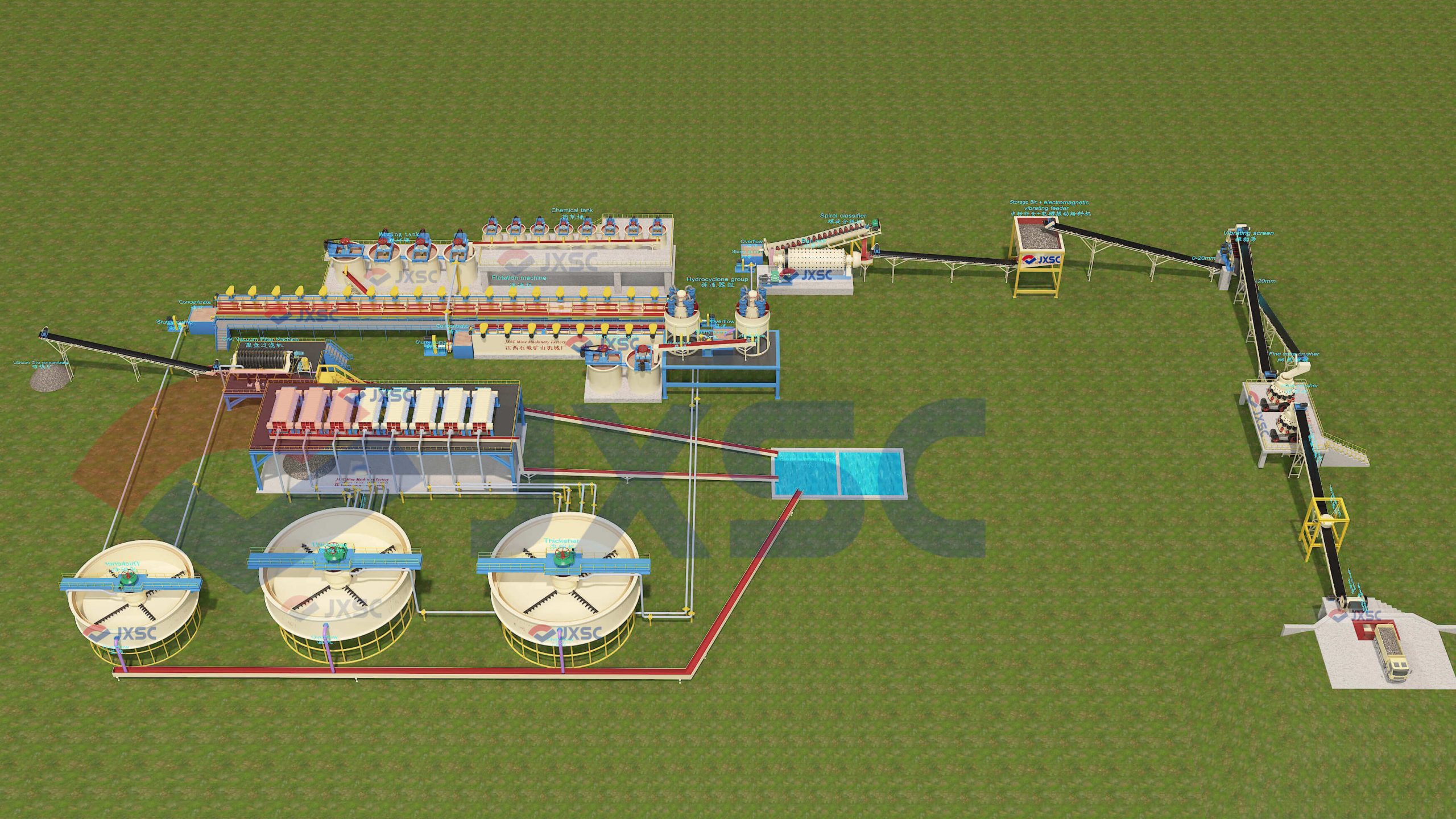
This project is a complete 1000TPD (ton/day) lithium ore flotation process plant tailored by JXSC for Nigerian lithium mining customers, realizing the integration of the entire process from crushing, grinding, desliming, and flotation to dewatering. The crushing system operates for 10 hours a day with a capacity of 100 tons per hour, while the grinding and flotation systems run 24 hours a day with a capacity of 42 tons per hour. By staggering the operating schedules of the crushing and the grinding-flotation circuits, the plant ensures a continuous supply of ore for the grinding stage while maintaining high operational efficiency and stability for all equipment. The lithium ore flotation process solution follows a strategy of “removing mica first, then recovering lithium” to achieve progressive enrichment. At the final stage, thickening and pressure filtration are employed to effectively dewater both the concentrate and tailings, while an integrated water circulation system helps reduce overall energy consumption. The entire production line is designed for high efficiency, energy conservation, and low operating costs, perfectly aligning with the requirements for high-throughput, continuous operation at the Nigerian mining site.
The 0–500mm raw ore is evenly fed into the jaw crusher for primary crushing via a vibrating feeder, reducing the output to 100–150mm. It is then further crushed into approximately 50mm by a cone crusher. The material is subsequently classified in a closed circuit using a vibrating screen equipped with a double-deck mesh (20 mm/40 mm). Coarse particles larger than 20 mm are returned to the secondary cone crusher for further reduction to below 20 mm, while the qualified fine material is conveyed to an underground storage bin located ahead of the grinding circuit. Given that the crushing capacity exceeds the grinding capacity, this underground bin serves as a buffer, preventing operational fluctuations caused by the capacity mismatch between the two stages.
A feeding system is installed beneath the underground ore bin to transport ore into a transfer hopper located ahead of the grinding mill. An electromagnetic vibrating feeder then ensures a uniform feed into the ball mill, where ore (initially <20 mm) is ground down to a size range of 0–1 mm, with 70%–80% of the material reaching a fineness of 200 mesh (approximately 0.074 mm). The ball mill operates in a closed-circuit configuration with a spiral classifier; coarse material (particles >0.074 mm) is automatically returned to the ball mill for further grinding, while the sufficiently fine pulp is directed to two sets of hydrocyclones for desliming. This stage effectively removes argillaceous (clay-like) impurities from the pulp, creating a clean and stable feed for the subsequent flotation process.
The deslimed ore pulp is fed into a conditioning tank, where chemical reagents are added according to a specific formula and thoroughly mixed. The pulp then enters an 8-cell flotation machine to remove mica—a critical step prior to lithium extraction, as it prevents mica from diluting the concentrate grade. Following the removal of mica, the material proceeds to the lithium concentrate enrichment stage, which consists of a three-stage sequential process: roughing (4 cells), scavenging (8 cells), and cleaning (7 cells), ensuring both high recovery rates and a high-grade concentrate.
The lithium concentrate produced via flotation is fed into a thickener, where a flocculant is added to accelerate solid-liquid separation and sedimentation. The thickened slurry is then pumped from the bottom of the thickener to a vacuum disc filter for dewatering, yielding a final lithium concentrate with an Li₂O grade of approximately 5%–6%. Meanwhile, the tailings generated during the production process are sent to two large thickeners for sedimentation and thickening, followed by dewatering in plate-and-frame filter presses. The clear overflow from each thickener is collected in a circulating water tank and returned to the upstream process, enabling the recovery and reuse of water resources.