We were established as the most specialized mineral processing equipment company since 1985.

This project is a 5 tons/hour tantalum-niobium tin separation plant located in Nigeria, with JXSC providing the complete beneficiation process design and equipment supply. Addressing the characteristics of alluvial placer deposits—coarse-grained particles and high clay content—the project primarily employs a modular combination of washing and screening, gravity separation, and magnetic separation. The classic combination of jigging and shaking tables achieves high recovery rates for high-specific-gravity tantalum, niobium, and tin minerals. Combined with dry magnetic separation, it achieves efficient enrichment of valuable metals such as tantalum, niobium, and tin, resulting in high resource utilization. The overall tantalum-niobium tin separation solution is suitable for small- to medium-scale placer mining scenarios, featuring high equipment reliability, low energy consumption, low operating costs, and rapid deployment and commissioning.
5TPH Alluvial Tantalum Niobium Tin Separation Plant
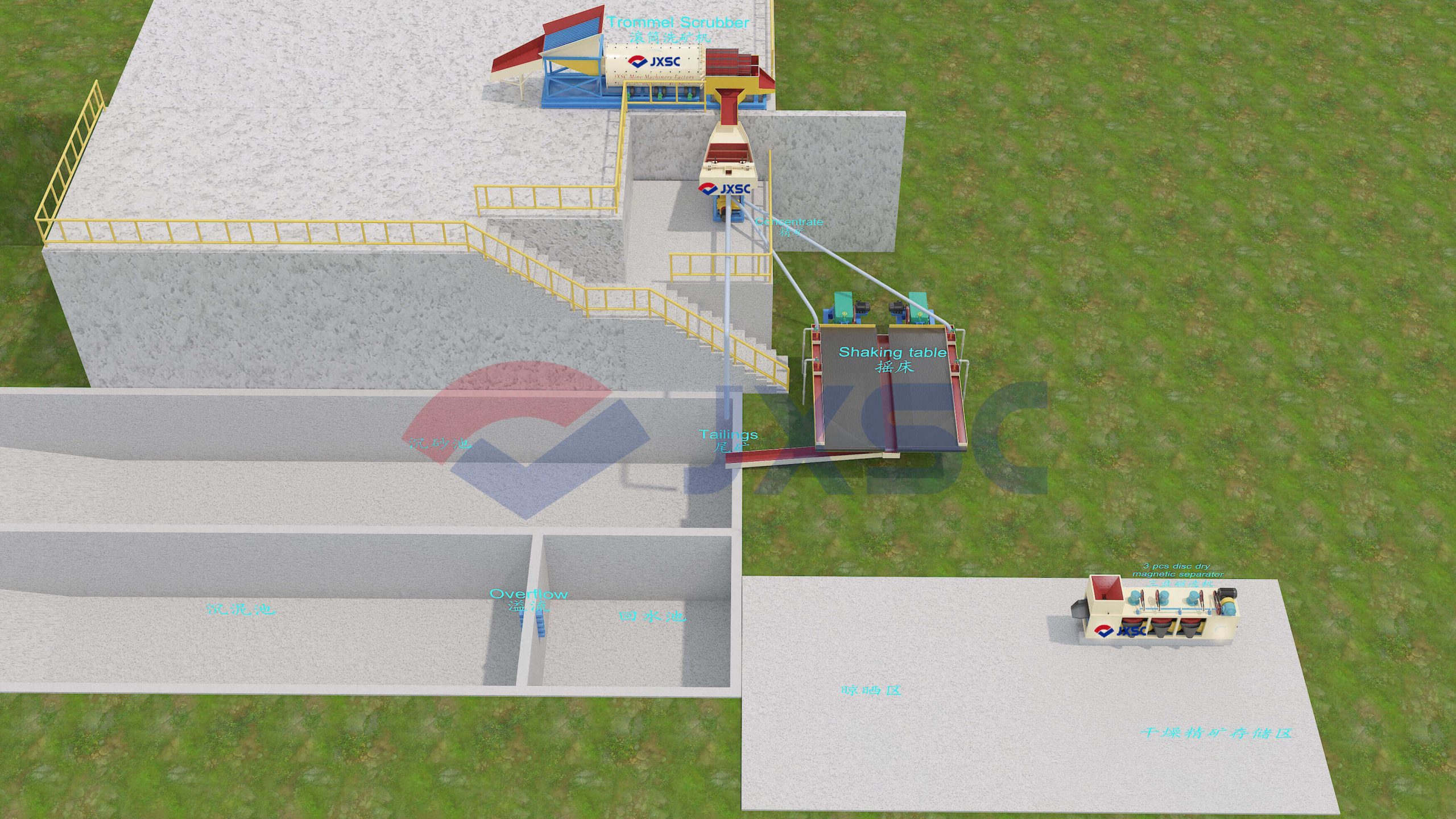
The raw ore is first fed into a drum washing machine for scrubbing and screening, and is divided into two categories according to particle size: large waste rock with a particle size of +5mm or more is directly discharged by belt conveyor; fine-grained ore with a particle size of -5mm or less enters the next gravity separation process to complete the initial desliming and impurity removal.
The fine-grained ore after screening is fed into a jig for gravity roughing, which utilizes the difference in mineral specific gravity to achieve preliminary enrichment. The tailings of the jig are directly discarded, and the produced rough concentrate is sent to a shaking table for fine cleaning.
The jig rough concentrate enters the shaking table for further gravity separation. The tailings produced by the shaking table are discharged into the total tailings. The obtained high-grade concentrate 1 (tantalum-niobium-tin mixed concentrate) is transported to the drying shed for natural drying to reduce the moisture content of the concentrate.
The dried mixed concentrate is fed into a three-disc dry magnetic separator, which separates three types of products by different magnetic field intensities: strongly magnetic minerals, weakly magnetic minerals (tantalum and niobium minerals), and non-magnetic minerals (tin minerals), ultimately achieving the separate recovery of multiple metals.