Vertical Ring High Gradient Magnetic Separator

Advanced HGMS: High Recovery & Purity for Weakly Magnetic and Non-Metallic Ores

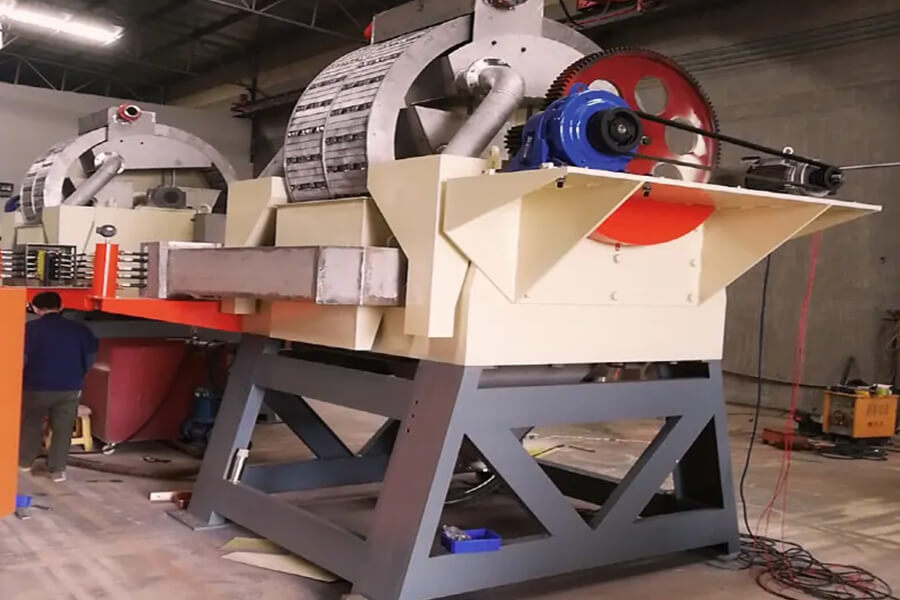
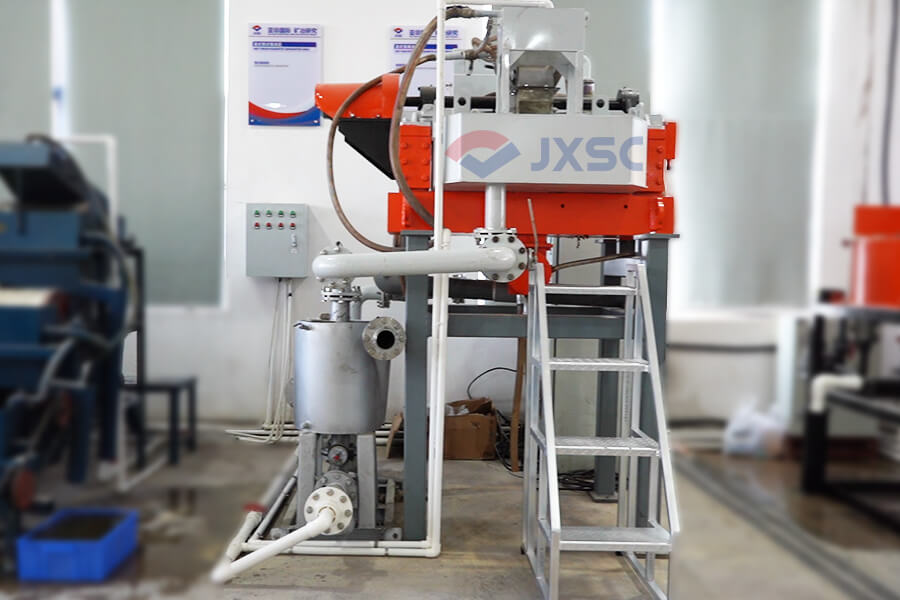
The vertical ring high-gradient magnetic separator is a device that utilizes a strong magnetic field gradient for magnetic separation, combining mechanical pulsation with magnetic separation technology. Through the design of a vertically rotating magnetic ring, a pulsation mechanism, and a high-gradient magnetic field, it achieves efficient and precise separation of fine-grained, weakly magnetic minerals. It is widely used in the purification of metal ores, the removal of impurities from non-metallic minerals, and solid waste treatment, ultimately achieving both high recovery rates and high concentrate grades. Its key innovation lies in the arrangement of the magnetic media and the precise control of the magnetic field strength, making it a leading weakly magnetic mineral separation equipment both domestically and internationally.

Brief Intro

Vertical ring pulsating high gradient magnetic separator, also known as pulsating High-intensity high gradient magnetic separator; abbreviated as HGMS. Its core technology lies in achieving precise separation of fine-grained, low-magnetic materials through a high-gradient magnetic field. It can capture micron-sized weakly magnetic particles while reducing the inclusion of non-magnetic impurities, achieving “high-efficiency enrichment + precise separation.” Examples include the enrichment and purification of weakly magnetic minerals such as hematite, ilmenite, wolframite, manganese ore, limonite, and tantalum-niobium ore. It can also be used for gradient separation of rare minerals such as tantalum-niobium ore and monazite, improving concentrate grades. It is most commonly used for removing iron impurities from non-metallic minerals such as quartz, feldspar, kaolin, fluorite, quartz sand, and silica sand, meeting the purity requirements of high-end photovoltaic glass, ceramics, and electronic materials.

Compared to other magnetic separation equipment, the vertical ring high gradient magnetic separator overcomes the limitations of horizontal rotating rings, making the magnetic media in the separation zone easier to wash. Its pulsation mechanism induces periodic vibrations in the slurry, reducing mechanical inclusions of non-magnetic particles. Combined with a backwashing system, it completely solves the problem of magnetic media blockage, extending maintenance cycles by over 50%. The JXSC high-gradient magnetic separator employs a multi-stage separation zone design (roughing, scavenging, and cleaning), enabling it to process lower-grade ores with high separation accuracy. It is highly adaptable to fluctuations in slurry concentration and particle size, and is widely used in mining, environmental protection, and renewable resources, serving as a key solution for improving concentrate grade and recovery rates.

Why Choose Our Vertical Ring High Gradient Magnetic Separator

Vertical Ring High Gradient Magnetic Separator 1

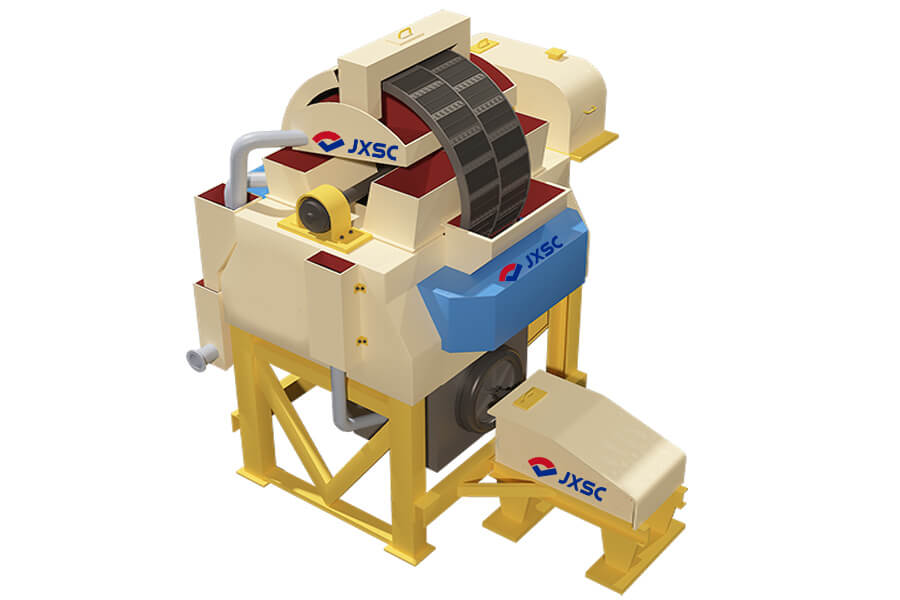
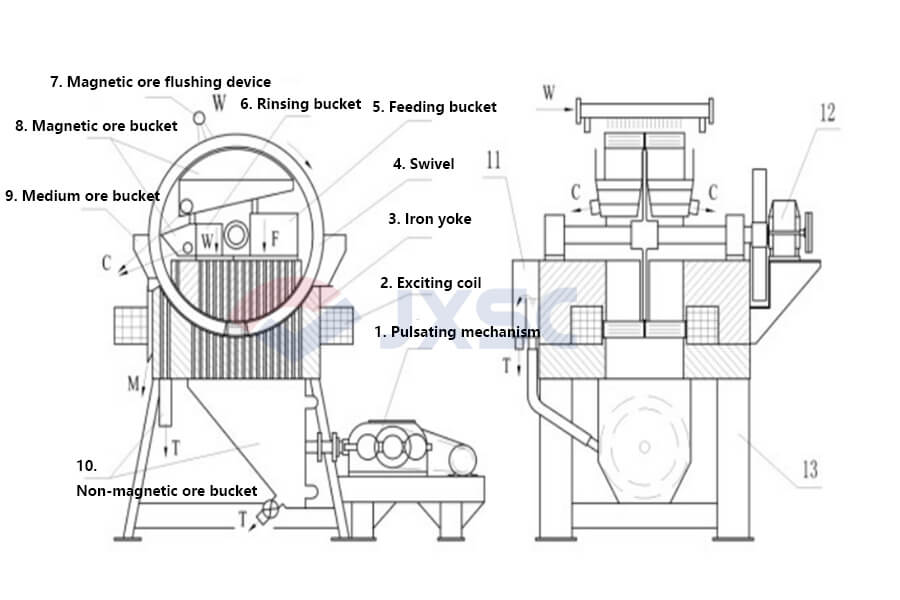
Vertical Ring System:

made of stainless steel, with built-in multi-layer magnetic media to support mineral adsorption and detachment.

Excitation Coil:

The core device generating a strong magnetic field, requiring a cooling system to maintain stable operation.

Magnetic System Module:

Employs rare-earth permanent magnets or electromagnetic coils to provide a stable background magnetic field.

Pulsation Mechanism:

Composed of an eccentric wheel, connecting rod, and pulsation box, this motor-driven piston-type device provides a pulsating flow of the slurry.

Flushing Water System:

High-pressure nozzle design for efficient removal of magnetic products.
Advantages

1. High-gradient magnetic field: Magnetic induction intensity can reach 0.6-1.4T, effectively separating nanoscale weakly magnetic minerals.

2. Continuous operation: Vertical rotating ring design allows for simultaneous sorting and washing, enabling 24-hour uninterrupted sorting without downtime for cleaning.

3. Energy-saving and environmentally friendly: JXSC’s high gradient magnetic separator uses a closed-circuit magnetic circuit reduces energy consumption, saving 30% compared to traditional equipment, and eliminates chemical pollution.

4. High adaptability: Covers multiple fields, including metallic and non-metallic minerals, and environmental protection; different magnetic minerals can be processed by changing the magnetic medium.

5. Long-life magnetic medium: Made of special stainless steel or composite materials, wear-resistant and corrosion-resistant, with easy replacement.

6. Automated control: One-button start/stop; PLC system adjusts parameters such as magnetic field strength and rotation speed, reducing manual intervention.

7. High recovery rate: Recovery rate of over 90% for fine weakly magnetic minerals, increasing concentrate grade by 10%~30%.

8. Modular design: Facilitates maintenance and upgrades; the magnetic system and rotating ring can be quickly replaced.

8. Low maintenance costs: The magnetic medium is not easily clogged, reducing downtime for cleaning and reducing the frequency of replacement of vulnerable parts.

Vertical Ring High Gradient Magnetic Separator Working Principle

Vertical ring high-gradient magnetic separators achieve separation based on the difference between the magnetic field gradient and the magnetic susceptibility of minerals. During operation, the slurry enters the separation zone from the top feed box, and the vertical rotating ring drives the magnetic medium (such as magnetic pole plates) to rotate in the magnetic field. An energized coil generates a background magnetic field, creating a magnetic field strength of 0.6-1.4T and a non-uniform gradient on the surface of the magnetic medium. Weakly magnetic mineral particles are adsorbed onto the medium and carried to a non-magnetic field area as the magnetic ring rotates, where they are washed away by the flushing water to form concentrate; non-magnetic mineral particles flow directly into the tailings trough through the gaps in the medium.

High Gradient Magnetic Separator Structure

Specification

Model

Background Magnetic Field

Feeding Material Size

Feeding Material Density

Dry Ore Capacity

Pulp Throughput

Excitation Power

Swivel Power

Pulsating Power

Swivel Diameter

Water Consumption

Host Machine Weight

Large Part Weight

External Dimensions

(T)

(mm)

(t/h)

(m³/H)

(KW)

(KW)

(KW)

(mm)

(m³/h)

(t)

(t)

(mm)

LH- 500

0.6-1.4

0-1

10-30%

0.01--0.05

0.25--0.5

6--20

0.18

0.55

500

0.65--1.4

1.5--4

0.25--0.5

1800x1400x1320

LH- 750

0.6-1.4

0-1

10-30%

0. 1--0.25

1--2

8--30

0.75

1.5

750

1.4--2.5

3.5--8

0.5--1.1

2000x1360x1860

LH- 1000

0.6-1.4

0-1.2

10-30%

2--4

12.5--20

10--40

1.1

2.2

1000

8--12

7--15

2--3.3

2700x2000x2400

LH- 1250

0.6-1.4

0-1.2

10-30%

5--10

20--50

12--50

1.5

3

1250

12--20

11--24

3.5--5

3200x2340x2700

LH- 1500

0.6-1.4

0-1.2

10-30%

10--15

50--100

15.5--60

3

3

1500

20--30

20--34

5--7

3600x2900x3200

LH- 1750

0.6-1.4

0-1.2

10-30%

15--20

75--150

23--72

4

4

1750

30--50

28--45

9--15

3900x3300x3800

LH- 2000

0.6-1.4

0-1.2

10-30%

20--30

100--200

29--85

5.5

7.5

2000

50--100

39--60

13--20

4200x3550x4200

LH- 2500

0. 6-1.4

0-1.2

10-30%

45--60

200--400

37--98

11

11

2500

100--150

83--125

18--32

5800x5000x5400

LH- 3000

0.6-1.4

0-1.2

10-30%

80--120

350--650

48--110

18.5

18.5

3000

150--250

135--165

19--38

7600x6500x7200

LH- 3600

0.6-1.4

0-1.2

10-30%

100--150

500--750

72--180

30

30

3600

200--400

150--250

25--50

7700x6500x7600


Frequently Asked Questions

The optimal particle size for sorting is 0.01-1.2 mm, which is a fine particle size; the required pulp concentration is 10%-30%; specific parameters need to be adjusted based on the mineral’s magnetic properties.

The processing capacity depends on the slurry concentration, particle size, and magnetic mineral content. The standard model has a processing capacity of 0.01~150 tons/hour. We can customize the separator based on parameters such as ore density, grade, slurry volume, site size, and separation difficulty to ensure a perfect match for your production line needs.

Yes, it supports stepless adjustment from 0.6 to 1.4T. Please contact our professional engineers for details to meet high-purity sorting requirements.

The equipment can process various materials, including weakly magnetic metallic ores, non-metallic ores, and solid waste.

When purchasing, you need to provide parameters such as the type of ore (e.g., hematite, quartz sand), raw ore grade, particle size distribution, and slurry concentration. JXSC also supports mineral processing tests to verify the equipment’s separation effect and ensure it meets your needs.

A horizontal concrete foundation is required, with sufficient space for maintenance (1.5 times the size of the equipment). Waterproofing and dustproofing are essential.

Water consumption per hour: 0.65~400m³ (from smallest to largest model); a matching recycled water system, such as a sedimentation tank + filter press, is recommended, which can achieve 90% water resource recycling and significantly reduce production costs.

Compared to other magnetic separators, its high recovery rate shortens the investment payback period. Costs can typically be recovered within 1-2 years through increased production, depending mainly on factors such as ore grade, value, and recovery rate.

Speak to Our Experts Today

Contact Us

illustration

search Products

JXSC LOGO dark

Speak to Our Experts Today

Contact Us