
- Home
- Blog
- Equipment Info
- Ball Mill Safety Checklist: Avoid Costly Workplace Accidents
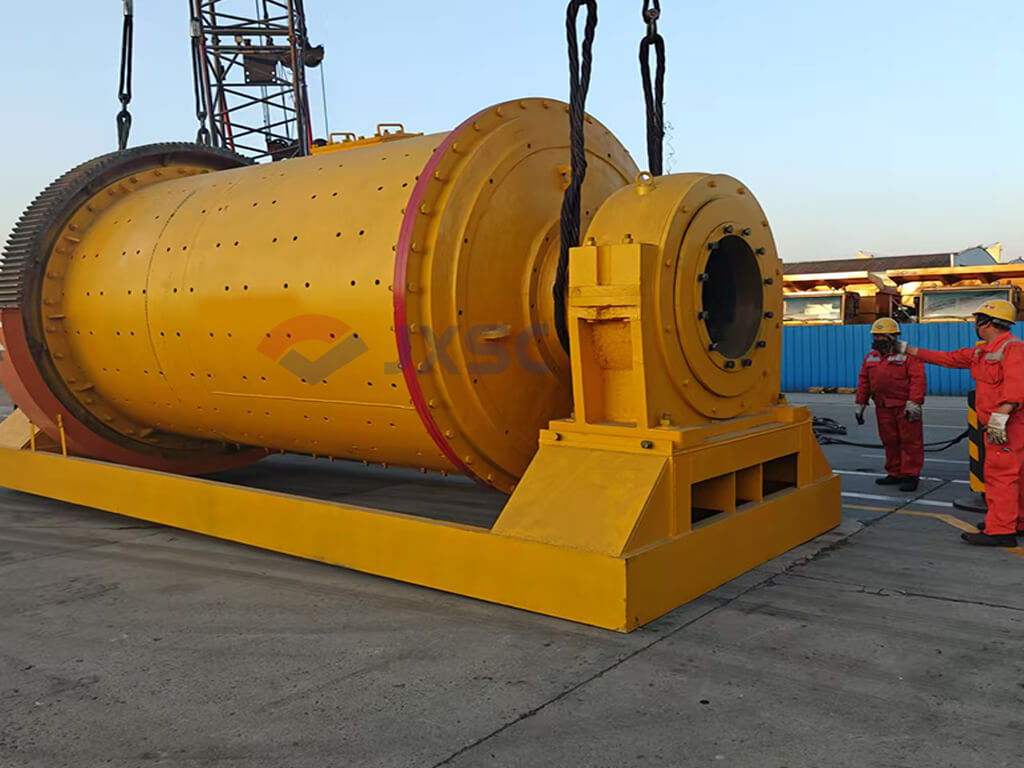
Three common types of ball mill accidents
(1) Mechanical Failure
If the bearings of a large ball mill operate under high loads for a long time, the gears, bearings, or motors are prone to fatigue and may break. This failure is often gradual, initially manifesting only as slight vibration or abnormal noise. However, if it is not detected in time, it may result in a shutdown for repairs, damage to the transmission system, or a production line shutdown for several weeks.
(2) Operational Errors
Many advanced ball mills are equipped with dual-locking systems and infrared safety warnings to prevent misoperation. For example, performing maintenance without completely shutting down the machine can lead to serious personal injury. Therefore, the most fundamental protection lies in rigorous training to ensure every operator is familiar with emergency plans and conducts regular safety drills to prevent such tragedies.
(3) Neglect of Maintenance
Insufficient lubrication in the ball mill’s lubrication system can lead to serious accidents due to increased frictional temperature. Ignoring lubrication and cleaning cycles can cause the frictional temperature of components such as bearings and gears to rise continuously, eventually igniting surrounding dust and potentially causing a fire.
Compliance is a must! Core items for ball mill safety inspection
1. Pre-start Inspection Requirements
● Foundation and Fixing Bolts:
The enormous centrifugal force generated during ball mill operation can cause bolts to loosen or even foundation settlement. Neglecting this could trigger a cascade of accidents, including equipment displacement and bearing damage. Therefore, before starting the machine, torque testing must be performed strictly in accordance with mechanical vibration assessment standards and industrial equipment installation specifications to ensure that all fixing bolts achieve the specified preload.
● Lubrication System Inspection:
As the crucial “blood system” for the safe operation of the ball mill, before starting the machine, check that the oil level in the tank is within the marked range and that the lubricating oil is not emulsified or showing signs of deterioration due to excessive impurities. Finally, test the stability of the oil supply pressure and clear the oil passages at each lubrication point to ensure all friction surfaces are adequately lubricated.
● Grinding Media Inspection:
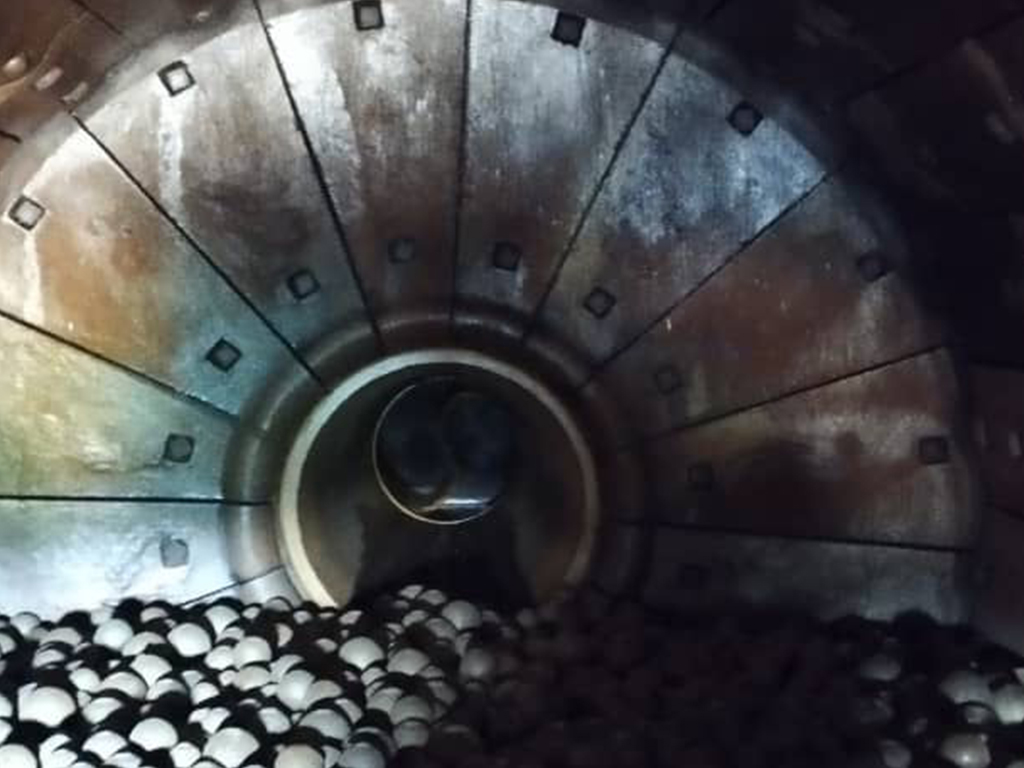
The grinding media inspection must confirm that the steel ball load in the cylinder meets the equipment’s rated requirements. Excessive loading increases the operating load, while insufficient loading reduces grinding efficiency.
● Qualification Inspection:
Measure the resistance, motor, and wiring to ensure they meet the ball mill safety power standards and avoid electrical hazards such as leakage and short circuits during operation. Subsequently, it is necessary to verify that operators are familiar with the ball mill’s safe operating procedures and emergency response procedures. Also, check whether they are wearing safety helmets, protective shoes, gloves, and face masks as required.
● No-Load Test Run Confirmation:
After all static checks are completed, briefly run the main unit by pressing the equipment start button. Observe the feed and discharge, cylinder, transmission parts, and vibration amplitude for any abnormalities.
2. 2. Real-time Monitoring During Operation
● Parameter Monitoring:
During ball mill operation, focus on monitoring whether the motor current remains within the rated range. The bearing temperature should not exceed 70℃; equipment vibration amplitude should be controlled within the rated range; if any parameter exceeds the threshold, investigate the problem immediately to prevent further damage.
● Status Monitoring:
During daily monitoring, constantly listen to the equipment’s operating sounds. Investigate any abnormal metallic friction or collision sounds promptly. Regularly check for slurry leakage in the cylinder gaps and observe whether the output particle size is uniform and stable.
● Operating Procedures:
Strictly adhere to the ball mill’s safety operating rules. Do not use tools to clear blockages from the feed or discharge ports while the equipment is running. Never place any part of your body near rotating parts to avoid workplace injuries.
● Abnormal Warnings:
If the motor current suddenly exceeds the limit significantly, the bearing temperature rises sharply within a short period, or the equipment vibrates violently, immediately press the emergency stop button to stop the machine and investigate. Restart only after the fault has been completely eliminated.
3. Post-Shutdown Maintenance and Inspection Requirements
● Normal Shutdown Procedure:
The ball mill safety shutdown procedure must be followed. Sudden power outages can cause material caking. For example, first stop the feed conveyor, let the equipment idle for 10 minutes to fully empty the cylinder of any remaining grinding material before shutting down the main unit. Afterward, wait for the components to cool down before shutting down to avoid sudden damage to high-temperature components.
● Post-Shutdown Inspection:
Promptly clean up any accumulated material around the equipment, check for loose fasteners, and record detailed wear data for liners and steel balls to provide a reference for subsequent maintenance.
● Long-Term Shutdown Maintenance:
Rotate the cylinder weekly to prevent deformation due to unilateral stress. Drain the lubricating oil and perform rust prevention treatment on the entire equipment. In addition, after disconnecting the main power supply, ensure proper dust protection.
Purchasing Pitfalls: 4 Essential Details for Ball Mill Safety Design
A. Formal Safety Certifications
When purchasing a ball mill, don’t just rely on the manufacturer’s general claims. CE certification must include a complete EC Declaration of Conformity. Especially for special operating conditions such as explosion-proof and high-temperature environments, confirm whether an authoritative third party has tested it.
B. Emergency Stop Buttons
If a ball mill malfunctions during operation, the braking system’s response time and stability directly affect the safety of personnel and equipment. Don’t just verify that the emergency stop function works; confirm that the emergency stop buttons are distributed at multiple points, and that the optimal trigger response time is 1-2 seconds.
C. Intelligent Monitoring System Interconnection Capabilities
Intelligent monitoring systems (such as shaft temperature and vibration alerts) can improve ball mill safety, but not all manufacturers offer a comprehensive suite. Core safety functions for ball mills, such as interlocking protective doors, overload protection, and trigger shutdown, should be prioritized.
D. Liner Material
The ball mill materials of key components, such as the cylinder and liners, directly affect service life and safety. When choose ball mill process, consider the operating conditions to avoid making blind choices. While carbon steel is relatively inexpensive, it is prone to brittleness in low-temperature or high-wear environments. Polymer composite materials are lightweight and impact-resistant, but unsuitable for high-temperature conditions. Although wear-resistant alloy steel is more expensive, it reduces replacement frequency and maintenance costs over the long term.
Ball Mill Safety Management Techniques
➡︎ Establish a standardized safety inspection log, clearly defining key indicators such as bearing temperature and vibration levels. Assign inspection responsibilities to specific individuals to reduce human error risks by over 90%.
➡︎ Strictly adhere to the manufacturer’s lubrication system specifications. Regular maintenance can extend the ball mill’s lifespan by 2-3 years.
➡︎ Implement the entire ball mill safety management process in advance, regularly updating safety inspection records to avoid non-compliance penalties and production downtime losses.
➡︎ For high-risk operating scenarios such as mining and grinding flammable and explosive materials, equip the mill with dedicated safety production liability insurance. This covers most expenses, including personnel injury compensation and equipment damage repair, and also allows for rapid production recovery after an accident.
Comprehensive Optimization of Ball Mill Safety Configuration
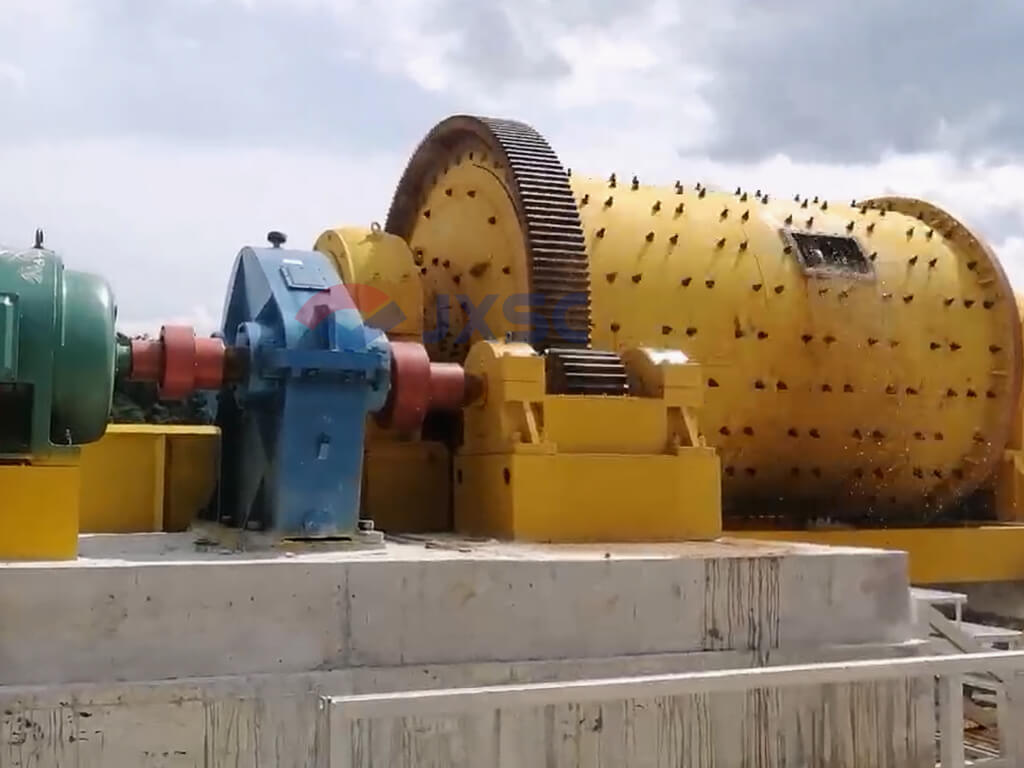
As a crucial piece of crushing & grinding equipment in industrial production, the safety management and efficient operation of ball mills directly impact a company’s production efficiency and economic benefits. By establishing a comprehensive safety inspection system, implementing standardized equipment maintenance procedures, and scientifically configuring safety insurance measures, buyers can effectively reduce equipment failure rates, extend service life, and significantly reduce the risk of safety accidents and economic losses. JXSC’s practical experience proves that a scientific ball mill management system can not only improve operating efficiency by more than 30% but also reduce maintenance costs by more than 40%.
Conclusion
We understand that every company’s production environment is unique. For optimal customization of your mining ball mill solution, please feel free to contact the professional technical team at JXSC Mine Machinery Factory to create a safer and more efficient mineral processing production line for you!

 English
  Spanish
  French
  Russian