
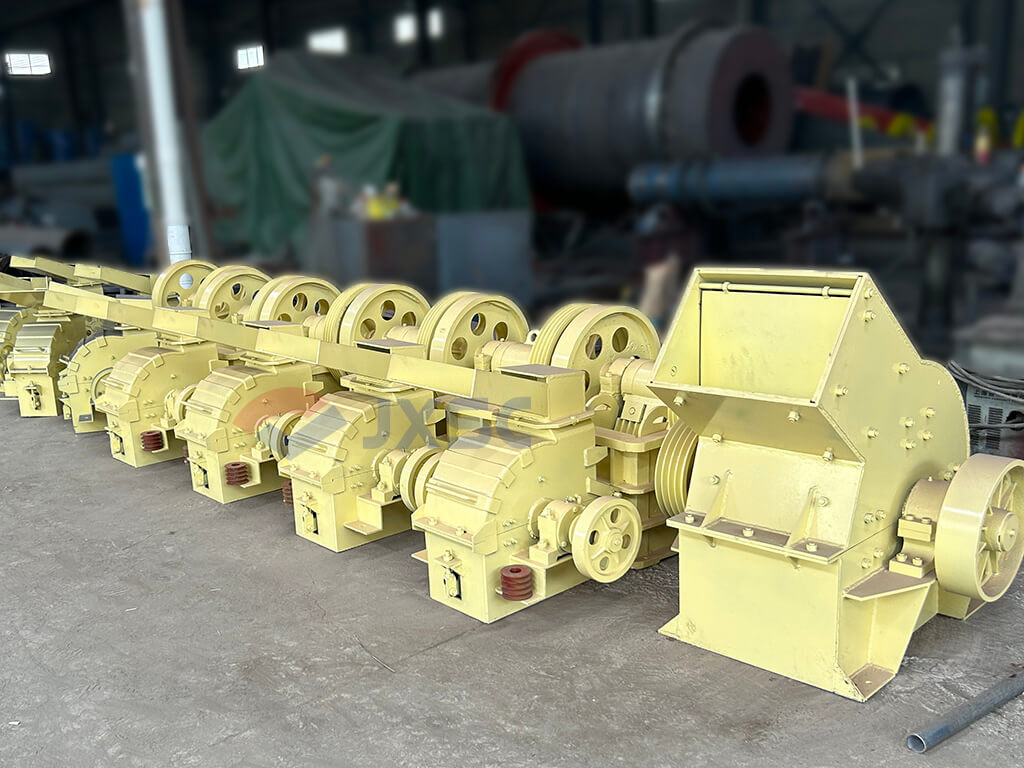
What is a Hammer Mill?
A hammer mill, also called a молотковая дробилка, is an industrial machine that utilizes high-speed impact force as its primary mechanism for crushing. Driven by an electric motor, the rotor—fitted with hammers—spins at high velocity, pulverizing materials fed into the crushing chamber into the desired particle size.
Hammer mills are classified by rotor structure into single-rotor (reversible/irreversible) and double-rotor types; by mobility into stationary, tracked, and wheeled types; and by function into heavy hammer, ring hammer, and energy-saving types. These hammer mill types are capable of processing a wide variety of medium-hardness, brittle materials, such as limestone, coal, gypsum, gold ore, and manganese ore. Due to its simple structure, high crushing ratio, and ease of maintenance, the hammer mill has become one of the most widely used types of rock-crushing equipment across sectors including mining, construction materials, quarrying, metallurgy, and road construction.
How Do Hammer Mills Work?
The core structure of a hammer mill consists of a rotating shaft, hammer heads, a screen, and a feed inlet. During operation, a motor drives the main shaft to rotate at high speed; under the influence of centrifugal force, the hammer heads are flung outward, violently striking the incoming material. After being subjected to this initial impact, the material undergoes secondary collisions and friction against the inner walls and the screen, resulting in further fragmentation. Smaller particles pass through the screen and are discharged, while larger particles are repeatedly struck by the hammer heads until they reach the desired size.
This dynamic crushing process endows hammer mills with high production capacity and operational flexibility, making them suitable for processing materials of varying hardness and structural composition. In addition, the particle size of the finished product can be quickly adjusted by changing the screen with a different aperture size to meet diverse production needs.
Core hammer mill types in 2026
(1) Type of Hammer Mills Based on Rotor Structure
Hammer mills can be classified into two types based on their rotor structure: single-rotor and double-rotor models. Single-rotor models utilize a single set of hammers; depending on their operational mode, they can be further subdivided into reversible and non-reversible types.
● The rotor of a single-rotor reversible hammer crusher is capable of bidirectional rotation, allowing both faces of the hammers to participate in the crushing process. This effectively doubles the service life compared to non-reversible models, making them suitable for the fine crushing of medium-hard materials.
● Non-reversible hammer mills feature a simpler structure, with the rotor rotating in only one direction. They are suitable for the medium crushing of materials of moderate hardness, such as limestone and gypsum. While their initial procurement cost is lower, they experience faster wear.
● Double-rotor hammer mills are equipped with two internal rotors that rotate synchronously; their feed opening is capable of accommodating larger-sized materials. With a production capacity reaching up to 300 tons per hour, they are well-suited for large-scale aggregate production lines involving materials such as basalt and granite. However, their price is nearly 50% higher than that of single-rotor models; furthermore, due to their substantial weight, they impose more stringent requirements on the installation foundation.

(2) Type of Hammer Mills Based on Mobility
Based on their installation method, hammer mills can be broadly categorized into three types: stationary, crawler-mounted mobile, and wheel-mounted mobile.
● Stationary hammer mills require the pouring of a concrete foundation and the installation of steel structural supports; they are best suited for fixed plant sites requiring long-term, stable production. While offering the lowest equipment cost, they cannot be relocated.
● Crawler-mounted mobile hammer mills feature a self-contained hydraulic drive system, allowing them to move independently within a job site without the need for truck towing. They are capable of navigating complex terrain but come at a higher price point. Characterized by their robust mobility, they are primarily suited for operations involving alternating work across multiple material yards or for construction waste recycling applications.
● Wheel-mounted mobile hammer mills are mounted on a semi-trailer chassis and require a tractor unit to tow them when relocating. They are approximately 30% less expensive than their crawler-mounted counterparts but are generally best suited for operations on flat mining sites.

(3) Type of Hammer Mills Based on Specialized Functions
For processing specialized materials, dedicated models—such as heavy-duty hammer mills, ring-hammer mills, or energy-efficient variants—may be selected.
● Heavy-duty hammer mills are equipped with heavier hammerheads, delivering an impact force that is more than 40% greater than that of standard hammer crushers. The heavy-duty hammer mill machines are ideal for single-stage processing of large, high-hardness materials, thereby eliminating the need for a primary crushing stage typically performed by a jaw crusher.
● Ring-hammer mills feature a ring-shaped hammerhead design that combines both impact and grinding actions; this configuration yields superior shearing effects, ensures uniform product granularity, and minimizes the generation of fine dust. They are primarily suited for crushing medium-hardness, low-abrasion materials such as coal and coke.
● Energy-saving hammer mills optimize rotor structure and grate gap and adopt variable frequency motor technology, resulting in lower unit power consumption than traditional models. These units are particularly well-suited for continuous-operation applications in small-to-medium-sized processing plants where energy costs are a critical consideration.

Hammer Mill 4-Step Decision-Making Method for First-Time Purchase
Step 1: Identify the Materials to be Processed
Key parameters to assess include the material’s Protodyakonov hardness (F-value), moisture content, and maximum feed size. Materials with a Mohs hardness below 3—such as limestone and gypsum—can be effectively processed using standard single-rotor hammer crushers. For materials with a hardness between 3 and 5—such as coal gangue and shale—heavy-duty hammer crushers or dual-rotor models are recommended. High-hardness ores (e.g., granite) specifically require heavy-duty hammer crushers. Materials with a moisture content exceeding 12% are prone to clogging the grate plates; for these, it is best to select a reversible hammer crusher equipped with scrapers or heating devices. If the feed size exceeds 800 mm, the material must first undergo primary crushing using a jaw crusher, or a heavy-duty hammer mill with a larger feed opening should be selected directly.
Step 2: Determine Capacity Requirements
Small-scale production lines (producing less than 50 tons per hour) are well-suited for single-rotor models. For medium-scale projects (50–200 tons per hour), a dual-rotor configuration is recommended. Large-scale aggregate projects may require the deployment of a cluster of mobile crushing stations. When making the final selection, it is advisable to incorporate a 15% to 20% capacity margin to compensate for potential efficiency losses caused by fluctuations in material hardness and moisture levels.
Step 3: Calculate Long-Term Costs
While high-manganese steel hammer heads are inexpensive, their service life is limited to just two or three months. In contrast, bi-metal composite hammer heads cost twice as much per unit but offer a service life that is three to five times longer; when calculated comprehensively, they prove to be the more cost-effective option. Ultimately, a holistic assessment of electricity consumption, labor costs, and losses incurred during maintenance downtime is required to select the hammer mill types that offer the best overall cost-performance ratio.
Step 4: Verify Supplier Credentials
Reputable suppliers—such as JXSC—possess comprehensive certification systems (e.g., CE, ISO) and established after-sales service networks. It is highly recommended to conduct on-site inspections of the supplier’s demo units to observe their actual operational performance and evaluate the quality of their after-sales support, thereby avoiding the pitfalls of misleadingly low-priced offers.
Alternative Crushing Solutions: Hammer Mill vs. Other Crushers
| Comparison Dimension | Молотковая мельница | Щековая дробилка | Шаровая мельница | Роторная дробилка | Валковая дробилка |
|---|---|---|---|---|---|
| Core Principle | High-speed hammer impact crushing | Movable jaw compression crushing | Steel ball grinding crushing | Blow bar impact + counter-attack | Blow bar impact + counter-attack |
| Применяемые материалы | Medium-hard brittle materials | Coarse crushing of various hard rocks | Fine grinding of powders | Shaping of medium-hard materials | Medium-fine crushing of brittle materials |
| Feed / Output Size | ≤800mm / 0~80mm | ≤1200mm / 50~300mm | ≤20-25mm / 0.075~0.5mm | ≤700mm / 10~60mm | ≤50mm / 2~20mm |
| Capacity Range | 1-300t/h | 1-1120t/h | 1-150t/h | 30-500t/h | 1.5~70t/h |
| Core Advantage | One-step shaping, large crushing ratio | Durable, easy maintenance | Extremely high grinding fineness | Good particle shape, cubic shape | Low dust, low over-crushing rate |
| Purchase Cost | Средний | Low | Высокий | Средний | Средний |
| Recommended for First Purchase | Cost-effective, wide application | Must-have for coarse crushing | Specialized for powder processing | Suitable for aggregate shaping | Suitable for brittle fine crushing |
Scientific Selection Makes Purchasing Crushers Twice as Efficient
From single-rotor to dual-rotor, from stationary to mobile, from heavy hammer to ring hammer—different hammer mill types determine completely different crushing efficiencies, operating costs, and maintenance cycles. As a first-time buyer, choosing a hammer mill crusher is not simply a matter of comparing prices; it requires a systematic decision that takes into account material characteristics, production capacity requirements, long-term costs, and supplier services. You do not need to be a machinery expert—simply follow these four steps: first, clearly define the materials to be processed; second, determine your production capacity requirements; third, calculate the long-term costs; and finally, verify the supplier’s credentials. By thoroughly executing each of these steps, you can avoid 90% of common purchasing pitfalls. The right equipment not only boosts production efficiency but also significantly reduces operational and maintenance expenses. If you are still deliberating over a customized production line solution or optimizing your equipment selection, please do not hesitate to contact us. JXSC горный машиностроительный завод offers complimentary technical consultations and on-site operational analyses to help you identify the most cost-effective rock crushing equipment for your needs!
 English
  Spanish
  French
  Russian