
Why is it that, given the same gold ore, some can extract the full value of the gold while others watch profits slip away? The answer lies in a crucial yet often overlooked step: gold mineral phase analysis. During processing, gold is neither uniformly distributed nor present in a single form; it may be hidden within the ore in various states—such as free-milling (leachable) gold, gold encapsulated in sulfides, or even gold in solid solution. Failure to accurately identify these “phases” results in persistently low recovery rates, ultimately undermining overall profitability. However, gold phase analysis is like giving the ore a “full-body ultrasound,” accurately identifying the state of existence of each type of gold, so that the ore beneficiation process can truly be “targeted.”
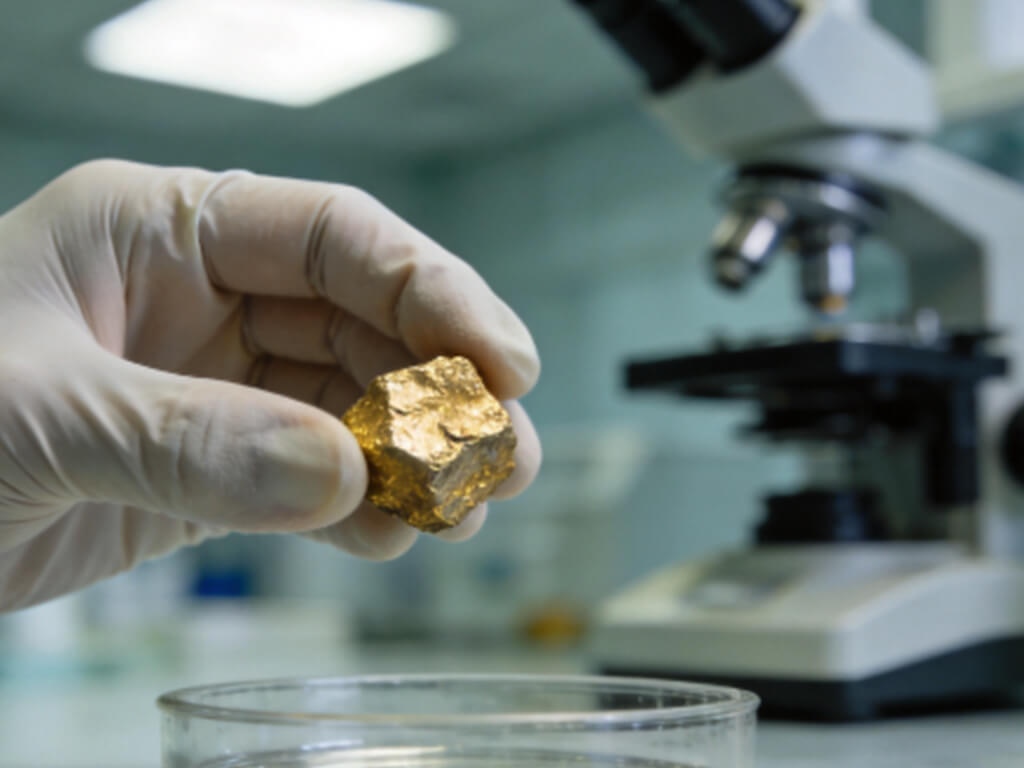
What is gold phase analysis?
Definition:
Gold phase analysis is a mineralogical method used to systematically identify the mode of gold occurrence in an ore. In particular, it enables the precise identification of gold’s microscopic distribution characteristics, providing a critical basis for determining mineral processing techniques.
There are four primary forms in which gold exists in ore: exposed gold, sulfide-encapsulated gold, silicate-encapsulated gold, and carbonate-encapsulated gold. Fundamentally, phase analysis addresses a core question: where exactly is the gold “hidden”? Is it exposed on the mineral surface, encapsulated within the crystal lattice of sulfides, or dispersed throughout gangue minerals?
Unlike traditional grade analysis, which only tells you “how many gold there is,” phase analysis tells you “in what form this gold exists.”
Gold Phase Analysis vs. Grade Analysis
| Dimensión | Grade Analysis | Phase Analysis |
|---|---|---|
| Core Answer | Total gold content (g/t) | Gold occurrence state (free or locked) |
| Detection Method | Fire assay or atomic absorption spectrometry | Chemical selective dissolution combined with instrumental analysis |
| Process Guidance | Limited — only total value known | Directly determines flowsheet structure and reagent regime |
| Escenario de aplicación | Daily quality assessment, economic accounting | Process design, process optimization, refractory ore evaluation |
| Coste | Low— tens of yuan per sample | Higher, but ROI can exceed tenfold |
| Data Value | Single numerical value | Multi-dimensional occurrence state spectrum |
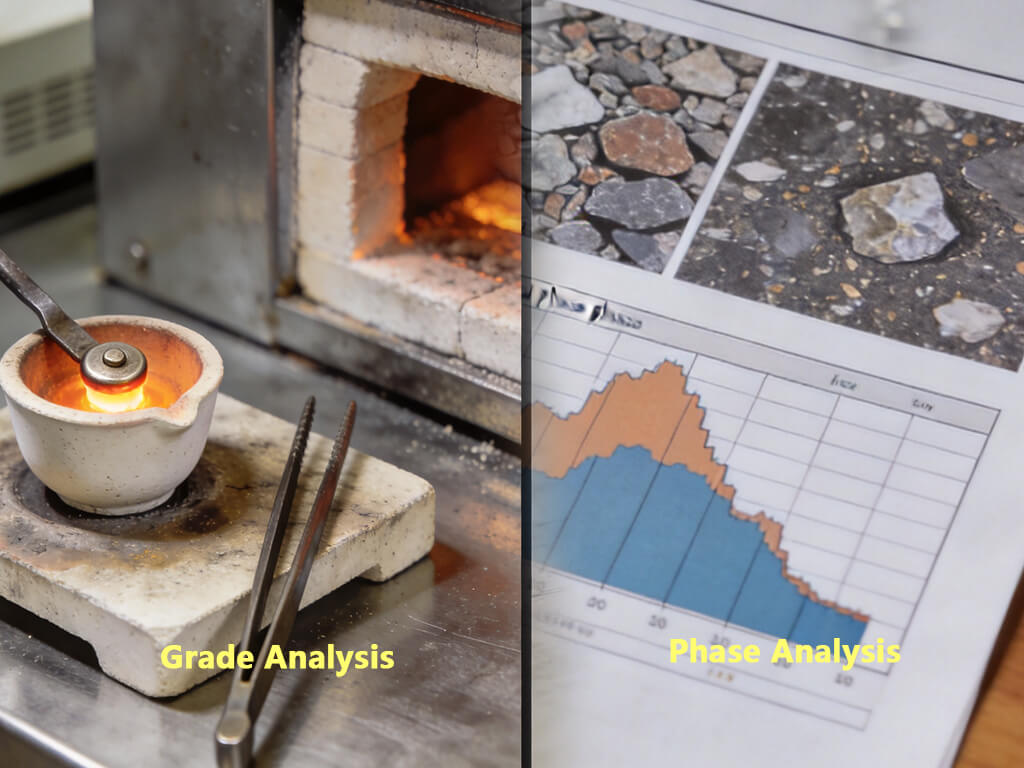
While ore grade simply indicates the gold content per tonne of ore; phase analysis reveals where the gold is located, whether it can be effectively recovered, and the appropriate recovery methods. The value of phase analysis lies in its ability to distinguish between “recoverable” and “refractory” gold. Free gold can be easily captured via gravity separation, whereas encapsulated gold requires additional pretreatment for liberation. Crucially, the findings of phase analysis directly dictate the choice of gold mineral processing solutions—whether gravity separation, flotation, cyanidation, or a combined approach—with every step relying on the data provided by this analysis.
4 Types Of Gold Phase
Four types of gold mineralogical occurrences:
➡︎ Exposed gold: Gold particles are directly exposed on the ore surface or within fractures, allowing for recovery without destroying the host mineral. Due to its ease of extraction, it is a prime target for the cyanidation process; however, its reserves are limited, typically accounting for a small fraction of the total gold content in the deposit. This type of gold can be recovered directly via separación gravimétrica and is the priority target for capture in processing plants.
➡︎ Sulfide-encapsulated gold: Gold exists as fine particles encapsulated within sulfide minerals such as pyrite, arsenopyrite, and pyrrhotite. Recovery requires initial concentration of the gold-bearing sulfides via flotación, followed by roasting or bio-oxidation to break open the encapsulation; this represents a core category of refractory gold ores.
➡︎ Silicate-encapsulated gold: Gold is embedded within silicates such as feldspar and quartz, making it difficult to access via conventional cyanidation. Recovery necessitates specialized processes, such as ultrafine grinding combined with chemically enhanced leaching.
➡︎ Carbonate-encapsulated gold: Associated with minerals like calcite and dolomite, this type requires acid or alkaline pre-treatment for liberation. Careful assessment of economic feasibility is recommended.
5 Common Methods and Its Functions for Gold Mineral Phase Analysis
(1) Chemical Phase Analysis
This method utilizes differences in the dissolution rates of various mineral phases in specific solvents to separate gold phase by phase through selective dissolution. It is the most classic approach, offering low costs and suitability for batch sample testing.
(2) Optical Microscopy
This involves directly observing the morphology, grain size, and dissemination characteristics of gold minerals under reflected and transmitted light. The process is simple and intuitive, making it suitable for preliminary screening, though it cannot detect extremely fine-grained gold.
(3) Scanning Electron Microscopy (SEM) Combined with Energy Dispersive Spectroscopy (EDS)
High-magnification microscopy and elemental mapping are used to precisely identify the mode of occurrence of gold and its associated minerals. SEM-EDS workflows are now fully automated, allowing microscopic analysis to be completed within one hour.
(4) Laser Ablation Inductively Coupled Plasma Mass Spectrometry (LA-ICP-MS)
This is a cutting-edge micro-analysis technique capable of locating sub-micron gold particles and determining their composition. It is particularly well-suited for detecting ultra-fine-grained encapsulated gold.
(5) X-Ray Diffraction (XRD)
This technique is used to identify the types and contents of gold-bearing minerals and to determine major mineral phases, such as quartz or sulfides. Although it does not detect gold directly, it provides crucial clues regarding the minerals with which the gold is associated.
The Core Importance of Phase Analysis in Mineral Processing
⏺︎ Avoiding Errors in Process Selection:
Grade data alone cannot distinguish between recoverable free gold and refractory encapsulated gold, making it difficult to determine the appropriate processing flow. Phase analysis identifies the form of gold occurrence beforehand, preventing haphazard processing and eliminating design flaws at the source.
⏺︎ Reducing Grinding Energy Consumption:
Knowing the gold’s dissemination size allows for the precise setting of grinding fineness. Coarse gold does not require over-grinding, while fine gold ensures sufficient liberation; this avoids energy waste while enhancing separation efficiency.
⏺︎ Optimizing Reagent Regimes:
Different gold phases respond very differently to reagents. Exposed gold is suitable for gravity separation, whereas sulfide-encapsulated gold requires flotation collectors; phase analysis enables targeted reagent selection.
⏺︎ Improving Overall Recovery Rates:
Traditional methods struggle to distinguish between free and encapsulated gold, leading to the loss of valuable gold. Phase analysis allows for the targeted optimization of processes such as leaching and flotation, significantly boosting gold recovery efficiency.
⏺︎ Lowering Operating Costs:
Accurate phase analysis reduces unnecessary pre-treatment steps and prevents reagent waste and equipment idling, directly lowering the cost of processing per ton of ore at the plant.
How Can Gold Mineral Phase Analysis Guide Mineral Processing?
Recommended Mineral Processing Flows for Different Gold Phase Types
| Main Gold Phase Type | Recommended Process | Process Characteristics | Escenario de aplicación |
|---|---|---|---|
| Predominantly Liberated Gold | Gravity separation direct recovery | No reagents, low cost, short flowsheet | Placer gold, coarse-grained vein gold |
| Predominantly Sulfide-Locked Gold | Flotation + Pretreatment | Pretreatment required, longer flowsheet | Refractory sulfide ore |
| Predominantly Silicate-Locked Gold | Ultra-fine grinding + Enhanced leaching | High energy consumption, high technical threshold | Micro-fine disseminated gold ore |
| Predominantly Carbonate-Locked Gold | Acid pretreatment + Cyanide leaching | Requires reagent consumption control | Carbonate-type gold ore |
| Mixed Type | Gravity-flotation-cyanidation combined process | Comprehensive recovery, complex flowsheet | Complex ore with uneven liberation grain size |
Conclusión
In summary, phase analysis serves as a bridge between geological resource assessment and mineral processing operations, acting as the crucial first step toward precise decision-making in mineral processing plants. Advanced technologies such as optical microscopy, SEM-EDS, and LA-ICP-MS can accurately identify the occurrence state of gold, such as exposed gold, sulfide-encapsulated gold, and silicate-encapsulated gold. From gravity separation to flotation, from roasting to enhanced leaching, every gold mineral processing flow decision should be based on phase data. While grade analysis provides quantitative data, mineral phase analysis reveals qualitative differences; both are indispensable in practical mineral processing.
We recognize that the ore characteristics of every mine are unique. JXSC is dedicated to providing tailored beneficiation optimization solutions for each mine. Whether your ore contains easily recoverable liberated gold or complex encapsulated gold, we can help you find the optimal solution.
 English
  Spanish
  French
  Russian