
Do you know the different types of spiral classifiers? In mineral processing, spiral classifiers rely on unique spiral propulsion and settling principles to accurately classify ore particles according to size and density, laying the foundation for subsequent mineral processing steps. However, many companies often fail to understand the characteristics of different types of spiral classifiers, such as high-weir and submerged spiral classifiers, which often leads to a mismatch between the equipment and the ore characteristics, resulting in efficiency losses. This article provides an in-depth analysis of the working principles, key types, and selection strategies for spiral classifiers, offering guidance on choosing the right equipment based on ore characteristics and production needs to help you achieve a more efficient and cost-effective mineral processing workflow.
What is a spiral classifier?
Definition:
Definition:
Les classificateur en spirale is a wet équipement de traitement des minerais that separates mineral slurry by particle size. It achieves classification by utilizing the differences in settling velocities of solid particles in water. Coarse particles settle to the bottom of the tank and are conveyed back to the broyeur à boulets for regrinding by the spiral, while fine particles remain suspended and are discharged with the overflow as the final product. This equipment is widely used for preliminary and check classification within grinding circuits. It is also capable of performing auxiliary operations such as ore washing, desliming, and dewatering. Favored by mineral processing plants for its simple structure, stable operation, and ease of use, it is a popular choice in the industry.
Principe de fonctionnement
During operation, the slurry enters the classifier through the feed inlet at the bottom. Agitated by the spiral blades, coarser particles—which settle rapidly—sink to the bottom of the tank and are conveyed upward by the blades for discharge. Meanwhile, the slurry containing finer particles flows out from the overflow end. The coarse particles (sand) are returned to the mill for regrinding. Throughout this process, the spiral classifier simultaneously transports the returned sand and maintains the suspension of fine particles, thereby establishing a complete closed-circuit grinding and classification loop.
4 Main Types of Spiral Classifiers
Type by weir height:
(1) High-Weir Spiral Classifier
● Overflow capacity: 32–890 m³/h
● Sand return capacity: 143–11,650 m³/h
● Structural features:
The tips of the spiral blades at the overflow end are positioned above the overflow level, while the central spiral shaft lies below it. This design creates a settling zone of optimal size, ensuring sufficient settling of coarse particles while maintaining an adequate flow path for fine particles to exit via the overflow. The spiral blade tips protrude above the water surface, facilitating observation and maintenance.
Applications:
Commonly used for coarse particle classification following the first stage of grinding—such as in pre-classification within a closed-circuit grinding process at mineral processing plants. It also performs well in the sand washing and desliming stages of sand and aggregate production lines.
Advantages:
Simple structure, high processing capacity, moderate energy consumption, and excellent cost-performance ratio.
Disadvantages:
Limitations regarding overflow fineness; separation efficiency is suboptimal when handling ultra-fine materials.
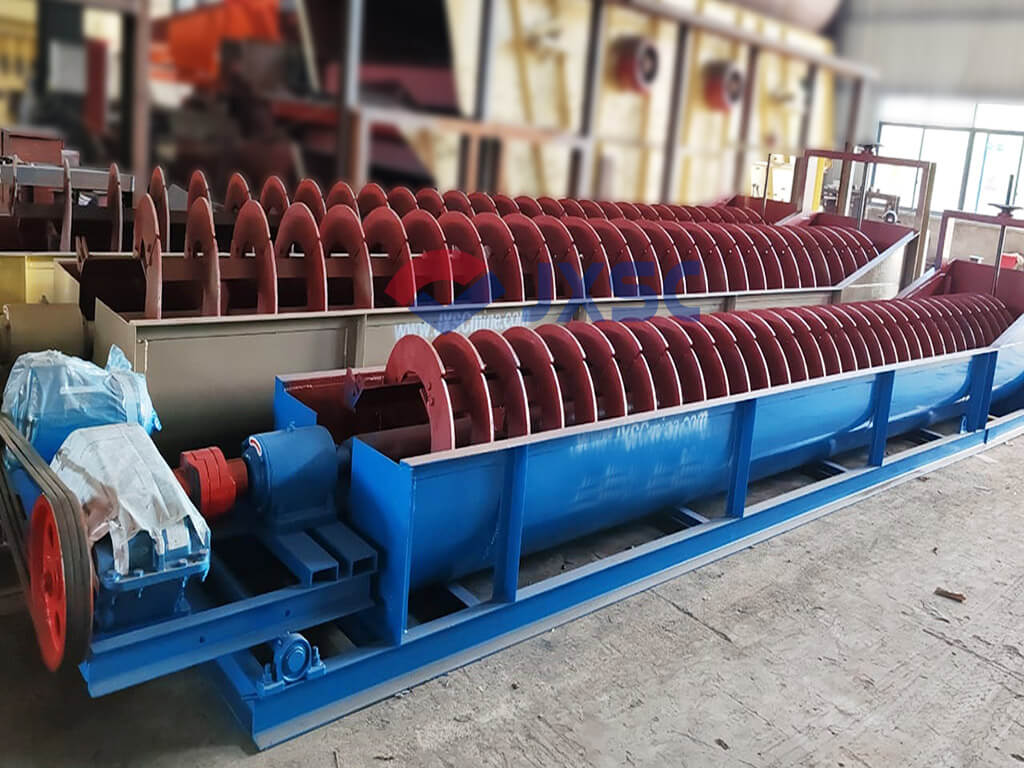
(2) Submerged Spiral Classifier
● Overflow: 75–705 m³
● Sand Return: 473–11,650 m³
● Structural Features:
The spiral blades are fully submerged within the settling zone below the overflow level. The tank is deeper and longer, creating a larger settling area that facilitates the thorough separation of fine particles. The fully submerged spiral design enhances classification precision for fine particles.
Applications:
Commonly used in secondary grinding circuits to meet the fine-particle requirements of downstream beneficiation processes. Also suitable for mineral processing operations requiring high classification fineness.
Advantages:
High classification fineness, superior overflow quality, and excellent processing precision.
Disadvantages:
Complex structure, relatively high equipment cost, and slightly lower processing capacity compared to the high-weir type.
Based on the number of spirals:
1. Single Spiral Classifier
● Overflow Capacity: 21–890 m³/h
● Sand Return Capacity: 145–11,650 m³/h
● Structural Features:
The tank houses a single spiral shaft, resulting in a compact and simple overall structure. The equipment features a small footprint, low cost, and ease of installation and maintenance. Spiral diameters typically range from 750 mm to 3,000 mm.
Applications:
Suitable for small-to-medium-sized mineral processing plants and operations with moderate throughput requirements. Commonly used in grinding circuits for small mines, as well as in auxiliary processes such as sand washing and desliming.
Advantages:
Simple structure, easy installation and maintenance, small footprint, and approximately 30% lower equipment investment cost compared to double-spiral models.
Disadvantages:
Limited processing capacity due to the single spiral; unsuitable for large-scale mineral processing plants.
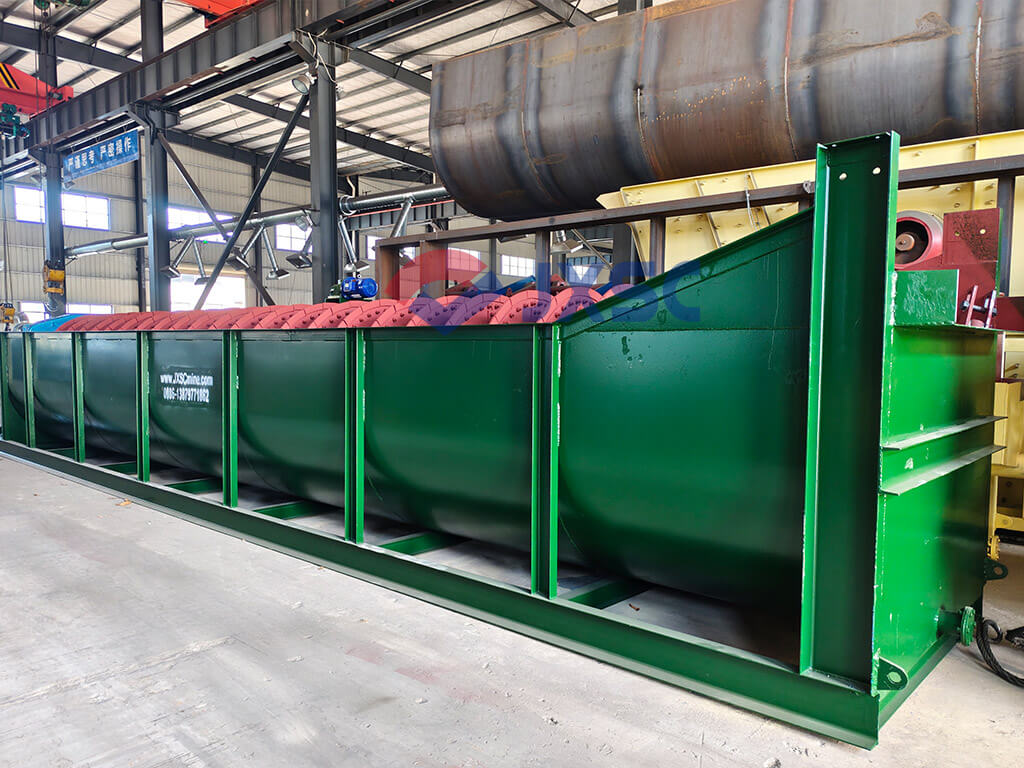
2. Double Spiral Classifier
● Overflow Capacity: 300–1,785 m³
● Sand Return Capacity: 2,290–23,300 m³
● Structural Features:
Two spiral shafts are installed side-by-side within the tank, rotating synchronously in opposite directions to boost capacity. The processing volume is approximately double that of a single-spiral model, offering significant efficiency advantages. The symmetrical structure ensures smoother operation and more uniform, thorough agitation.
Applications:
Suitable for large- and medium-sized mineral processing plants and high-throughput production environments. Many large-scale mines and sand/aggregate production lines worldwide utilize the double-spiral design to meet output requirements. For instance, the model with a 3,000 mm spiral diameter offers a sand return capacity of up to 23,300 tons per day.
Advantages:
Large processing capacity, suitable for large-scale production, and outstanding benefits.
Disadvantages:
Higher initial investment and footprint costs; installation and commissioning are more complex.
Comparative Analysis of 4 Types of Spiral Classifiers
| Comparison Dimension | High Weir | Submerged | Single Spiral | Double Spiral |
|---|---|---|---|---|
| Overflow Particle Size | Coarse particles | Fine particles | Depends on weir/submerged type | Depends on weir/submerged type |
| Structural Complexity | Simple | Modéré | Simple | Relatively high |
| Capacité de traitement | Overflow: 32-890 m³ Sand Return: 143-11,650 m³ | Overflow: 75-705 m³ Sand Return: 473-11,650 m³ | Overflow: 21-890 m³ Sand Return: 145-11,650 m³ | Overflow: 300-1,785 m³ Sand Return: 2,290-23,300 m³ |
| Coût de l'équipement | Low | Haut | Low | Haut |
| Typical Application | Coarse classification in primary grinding | Fine classification in secondary grinding | Small and medium-sized plants | Large-scale plants |
| Core Advantage | High cost-effectiveness | Large settling area, high classification fineness | Cost-friendly | Outstanding capacity |
How to Choose the Right Spiral Classifier
Six Key Factors for Equipment Selection
Ore Properties: Understanding the ore type, hardness, and particle size distribution is the starting point for selection. Differences in specific gravity and settling characteristics require distinct approaches.
Grinding Fineness: The required overflow particle size is the decisive factor in choosing between the high-weir and submerged types. A high-weir model suffices for particle sizes of 0.2–0.9 mm, whereas a submerged model is required for 0.07–0.2 mm.
Capacité de traitement: Match the equipment specifications to the plant’s design capacity, ensuring sufficient capability for handling both sand return and overflow. A high-weir model with a 2,000 mm diameter offers a sand return capacity of up to 5,900 m³ per day; please contact us for selection assistance.
Consommation d'énergie: Motor power directly impacts daily electricity costs. Dual-spiral drive motors can reach 44 kW; high-energy-consumption models require careful consideration.
Footprint: Equipment dimensions must fit the actual space constraints of the plant. Dual-spiral models are roughly twice as wide as single-spiral models, so footprint differences must be calculated in advance.
Budget: Comprehensively evaluate the total investment, including equipment purchase, transport, installation, and long-term maintenance. Single-spiral high-weir models have the lowest cost, while dual-spiral submerged models require the highest investment.
Decision: High-Weir vs. Submerged Type
If the required overflow particle size is relatively coarse, the high-weir type is suitable and more cost-effective. If a fine-particle product is required, the submerged type must be selected to ensure quality.
Selection Advice: Single-Spiral vs. Dual-Spiral
For small- to medium-sized processing plants with capacities within a few thousand tons, a single-spiral model is sufficient. When higher capacity is required, the advantages of the dual-spiral model become apparent. Additionally, space and budget are factors to consider; the single-spiral model is often the more practical choice.
Conclusion
Ranging from high-weir to submerged types and from single-spiral to double-spiral configurations, these four main types of spiral classifiers each have their own specific applications and performance limits. High-weir classifiers are preferred for coarse particle classification, whereas submerged types are suitable for fine particles; single-spiral models offer greater cost-efficiency for small- to medium-scale processing plants, while double-spiral models ensure superior stability and throughput for large-scale production lines. Furthermore, selecting the right equipment requires a comprehensive assessment of key factors such as ore characteristics, processing capacity, energy consumption, and budget. JXSC will provide one-on-one mining equipment and customized mineral processing solution design based on your ore properties, production targets, and budget.

 English
  Spanish
  French
  Russian